Recovery is Hard, Especially Without Quality Sleep
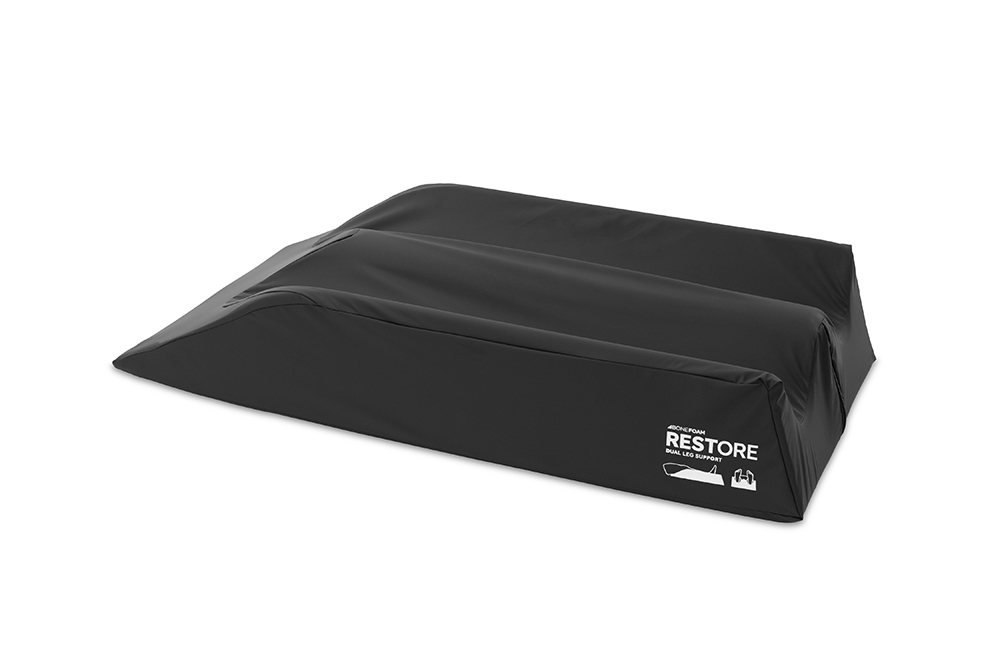
The BoneFoam Restore Dual Leg Support exists to solve one problem well — helping patients sleep comfortably and neutrally after knee surgery. By comprehensively addressing alignment, symmetry, and gentle elevation, Restore transforms nighttime from a liability into an asset in recovery.
When Nighttime Positioning Undermines Recovery
Sleep disturbances following knee surgery are common and well documented, whether after a total knee arthroplasty, an ACL reconstruction, or other ligament and cartilage procedures. In fact, a large majority of patients experience significant sleep disruption in the early postoperative period, often persisting weeks beyond hospital discharge.¹ ² Poor sleep has been associated with increased pain sensitivity, delayed functional recovery, higher pain medication requirements, and reduced overall patient satisfaction following orthopaedic procedures.³ ⁴ At the center of this issue is poor nighttime positioning.
Design Rooted in Lived Experience
The BoneFoam Restore Dual Leg Support was not conceived in a lab or through a marketing exercise. Restore was developed through collaboration between an orthopaedic surgeon and his athlete patient who had undergone several knee procedures and experienced firsthand how difficult it was to sleep comfortably after surgery. Despite following proper rehabilitation protocols during the day, nighttime recovery remained consistently problematic. Improvised solutions such as stacked pillows or wedges failed to maintain comfort or alignment throughout the night.
From this shared clinical and patient journey, three recurring contributors to nighttime discomfort became overwhelmingly clear:
1. There is a substantial loss of neutral lower-extremity alignment. When patients lie supine (laying on their back) without structured support, the legs naturally fall into external rotation and valgus drift. While this may be tolerable for healthy limbs, following knee surgery it can increase strain and discomfort around the joint. Persistent malalignment promotes guarding and discomfort that disrupt sleep continuity.
2. A second challenge is asymmetrical elevation between limbs. A common home strategy is elevating only the one operative leg while leaving the other non-operative limb flat. This creates pelvic asymmetry and rotational stress through the hips and lumbar spine. Biomechanical studies have demonstrated that uneven lower-extremity positioning alters pelvic mechanics and increases strain, reducing tolerance for sustained supine rest.⁵
3. Finally, many patients encounter discomfort from aggressive or unstable elevation. While elevation is important for swelling control, steep angles or unstable pillow stacking can make the back of the knee feel tighter while causing muscles to tense up. Rehabilitation literature consistently favors low-load, prolonged positioning over forceful or inconsistent support, particularly during rest periods.⁶
Intentional design. Better sleep.
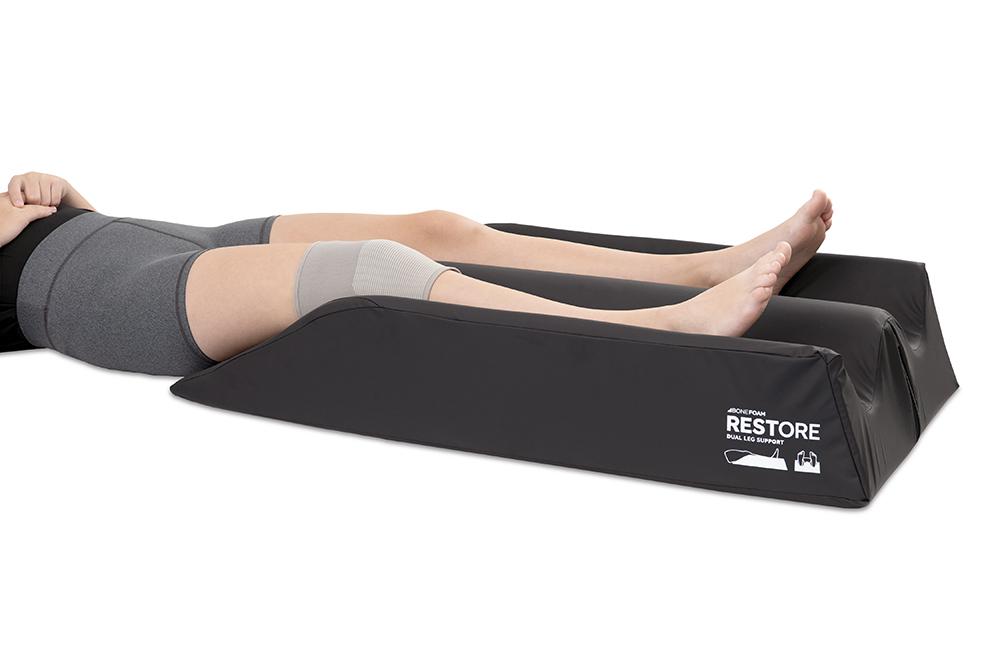
Patients who sleep better recover better. This relationship is intuitive and increasingly supported by orthopaedic and pain-science literature. What distinguishes Restore Dual Leg Support is not complexity, but restraint. It does not immobilize or aggressively correct posture. Instead, it creates a stable, repeatable supine position (laying on your back) that patients can tolerate for hours, night after night.
This design philosophy, born from a surgeon’s clinical understanding and an athlete’s lived recovery experience, reflects a broader BoneFoam principle that positioning should work with the body, not against it. Due to its intentional design, Restore clearly distinguishes itself from other positioning products that lack the same clinical insight and lived experience. While some alternatives may be offered at a lower price point, they often do so at the expense of quality, durability, and intentional support.
.jpg)
Reframing Sleep as a Positioning System
The Restore Dual Leg Support was designed to treat nighttime as a critical phase of recovery, deserving the same intentionality as therapy. Rather than supporting one limb in isolation, Restore addresses the entirety of the lower extremity system. Parallel support channels maintain bilateral neutral alignment, preventing external rotation and valgus drift that commonly provoke discomfort. By supporting both limbs equally, pelvic symmetry is preserved, reducing strain in the hips and lower back.
The Restore system provides gentle, sustained elevation, sufficient to support proper blood flow and swelling reduction without forcing extension or provoking guarding. This approach aligns with established rehabilitation principles emphasizing passive positioning to improve adherence during prolonged rest.⁶
Why Nighttime Positioning Matters
Nighttime positioning influences several interconnected recovery variables:
1. Pain control: Better alignment and less muscle guarding reduce pain signals³ ⁴
2. Swelling reduction: Gentle elevation of both legs helps improve circulation and decreases swelling⁶
3. Recovery capacity: Improved sleep supports tissue healing and daytime rehabilitation performance¹ ²
For more information or to purchase the BoneFoam Restore Dual Leg Support, click here.
References:
- Wylde V, et al. Acute postoperative pain at rest after hip and knee arthroplasty: severity, sensory qualities and impact on sleep. Orthop Traumatol Surg Res. 2011;97(2):139–144.
- Gibian JT, et al. Sleep disturbances following total knee arthroplasty. J Arthroplasty. 2023;38(6S):S120–S124.
- Finan PH, et al. The association of sleep and pain: an update and a path forward. J Pain. 2013;14(12):1539–1552.
- Schrimpf M, et al. Sleep deprivation and pain perception: a meta-analysis. Sleep Med Rev. 2015;24:1–7.
- McClelland JA, et al. Lower limb biomechanics and pelvic alignment during functional tasks. Gait Posture.2011;34(2):248–253.
- Lindenfeld TN, et al. Rehabilitation considerations following knee surgery. J Orthop Sports Phys Ther.1999;29(6):349–361.