
For nearly two decades, BoneFoam has worked on a single problem in the operating room: patient positioning.
Watch a lateral surgical case unfold, and you'll often see the same gradual progression. The patient is anesthetized and intubated in the supine position before being carefully turned onto their side and positioned in a true lateral orientation. Bumps are placed, pillows are stacked, and the torso is strapped and securely braced into position. Then the case begins, the team leans in, the retractors load, and degree by degree the patient rolls forward. By the time anyone notices, the “true lateral” that the plan depended on is no longer true, and the access the anesthesia team needs is buried under the supports that were supposed to hold everything still.

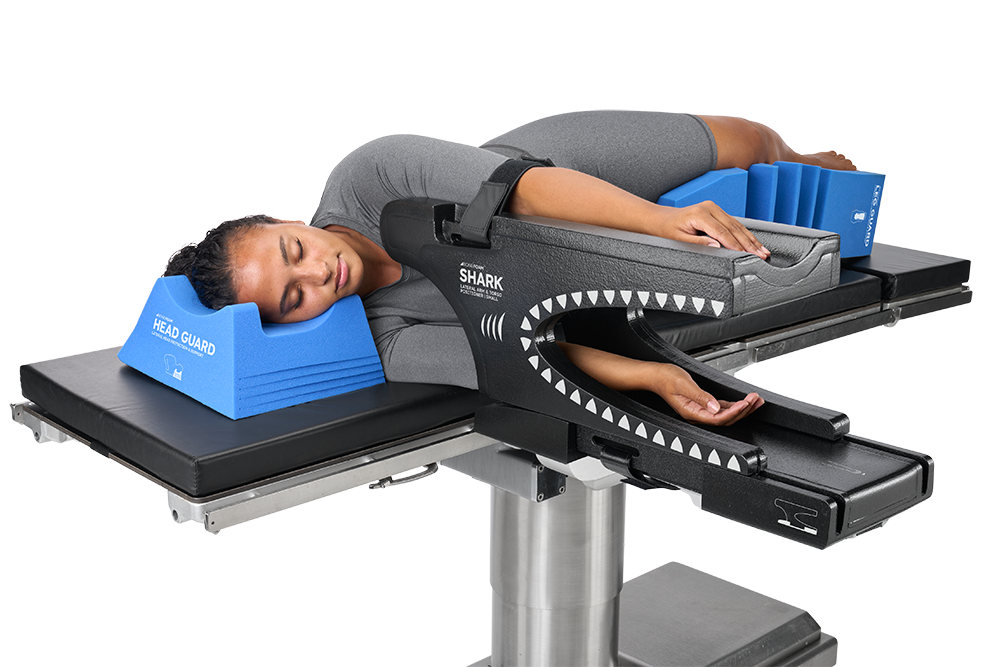
(above photo) The BoneFoam Shark for lateral patient positioning
BoneFoam has spent the better part of two decades focused on the surfaces beneath the patient, we want to make a focused argument for the lateral position. Stability and anesthesia access are not comfort features. They are determinants of the outcome, and the makeshift bumps, pillows, and improvised supports that still serve as the standard were never designed to reliably provide either.
Procedural Focus: The Posterior-Approach Lateral Family.
The lateral decubitus position is the workhorse for a whole family of posterior-approach procedures — lateral lumbar interbody fusion and other lateral spine work, lateral-approach total hip arthroplasty, and a range of lower-extremity and other procedures that depend on the patient lying truly on their side. ¹ Across all of them, three requirements are constant: the torso must stay in a stable, reproducible true lateral that does not drift during the case; the dependent arm and brachial plexus must be protected; and anesthesia has to keep access to the airway, lines, and leads from the moment of induction through the close. An improvised setup tends to fail all three at once.
The Positioning Problem: Why “Good Enough” Lateral Isn’t Good Enough
This is the part worth slowing down on, because each failure has a literature trail and a downstream cost. The patient rolls forward and the roll changes the operation. Conventional lateral positioning is, in the words of a recent systematic review, highly imprecise, with additional loss of position occurring throughout the procedure. This unintended movement often goes unrecognized and introduces substantial error.² In lateral-approach hip arthroplasty this is quantified and sobering: pelvic roll averages around 9.5° and is anterior in 96% of cases, and a roll of just 13° can push an otherwise perfectly oriented acetabular cup outside the conventional ±10° safe zone³ — a miss strongly associated with dislocation, accelerated wear, and revision.²ʼ³

(above image - current approach) In lateral spine work, where the patient is often taped down to hold the table break and the true lateral, the same anterior drift rotates the patient off the true-lateral reference the surgeon and the fluoroscopy depend on, distorting the working corridor. The makeshift bump that felt solid at setup is exactly what does not hold.
The dependent arm is where the nerves are at risk. The lateral position concentrates neurovascular risk on the down side: the main mechanism of dependent brachial plexus injury is compression between the thorax and the humeral head,⁴ and the position carries the highest position-related nerve-injury signal of the common surgical postures — intraoperative SSEP changes have been reported in roughly 6.5–7% of lateral cases versus 1.8–3.2% in supine positions.⁵ Ulnar-nerve and brachial-plexus injuries are, unsurprisingly, the most commonly claimed positioning injuries in malpractice data.⁶ The arms must be supported and stabilized, not just taped out of the way.
Anesthesia loses crucial access at exactly the wrong surgical timeframe. Turning lateral changes respiratory mechanics — pulmonary compliance falls and ventilation favors the nondependent lung⁷ — at the same moment the airway, the dependent arm’s lines, and the monitoring leads become harder to reach. When the upper arm and chest are bolstered and strapped down, the access anesthesia needs throughout the case is the first thing to disappear.
Manual lateral positioning is time consuming and difficult to reproduce. Makeshift bumps, stacked pillows, improvised supports, and, in lateral spine surgery, complex tape configurations are assembled differently by every team for every case. The result is the opposite of the standardization the rest of the operating room is working toward.
Modern solution: The Sideline Lateral Lumbar Positioning System includes a small Shark

The Solution: The BoneFoam Shark
The requirement, then, is a single device that holds the torso in true lateral, protects and positions the arms, and keeps anesthesia’s access open, without reverting to an improvised stack of bumps and pillows. That is what the BoneFoam Shark is built to do. A stabilization innovation like no other, the Shark is designed to position the arms and stabilize the torso in the lateral position. Its defining feature is a soft yet stable buttress against the anterior shoulder that prevents the patient from rolling forward, directly countering the anterior drift that the hip and spine literature identifies as the core failure mode of conventional lateral setups.²ʼ³ Because the buttress controls the torso from the front, it also leaves open access to the lines and leads anesthesia relies on, rather than blocking them behind bulky improvised supports.⁷

Two design choices make it practical in the real workflow:
- A two-piece design that fits how lateral cases run. Every lateral case begins the same way: the patient is anesthetized and intubated supine, then flipped into the lateral position. The Shark is built around that sequence: the base is set, the patient is rolled onto their side, and only then is the upper arm placed onto the memory-foam top. The arm support is added after the turn rather than wrestled into place during the turn, and the arm lands on a cushioned, supportive surface rather than an improvised misfitting bump.
- Memory-foam arm support that cradles and stabilizes the arms, addressing the dependent-arm and brachial-plexus exposure that makes the lateral position risky in the first place.⁴ʼ⁵ The Shark is available in small and regular sizes to fit different patients.

The Benefits: What Changes in the Lateral OR
- True lateral that holds — an anterior-shoulder buttress that resists the forward roll which, uncorrected, drifts a hip cup out of its safe zone and rotates a spine off its fluoroscopic reference.²ʼ³
- Protected arms — memory-foam support that positions and cushions the arms, addressing the dependent brachial plexus rather than leaving it to an improvised bump.⁴ʼ⁵
- Anesthesia keeps its access — because the buttress controls the torso from the front, the lines and leads stay open and reachable throughout the case, instead of lost behind bulky supports.⁷
- A workflow that matches the case — intubate supine, roll lateral, set the upper arm on the foam top; faster and more repeatable than building and rebuilding an improvised setup.
- Sizing for real patients — small and regular options with contours to accommodate the breasts instead of one improvised shape for everyone.
The Rising Tide of Patient Positioning
There is a bigger reason patient positioning matters in the current healthcare landscape. As navigation and robotics have swept into spine and joint surgery, the value of these platforms has come to depend on something they do not themselves provide: a stable, reproducible patient and patient scenario. Reproducible positioning has become the “missing layer” of platform performance and it has drawn the attention of the market’s top platform leaders precisely because navigation and robotic accuracy are only as good as the stability of the patient on the table.
Operating room time is among healthcare's most valuable resources. Depending on the institution and methodology, published estimates place the value of OR time between approximately $15 and over $130 per minute, with contemporary literature reviews reporting an average of approximately $46 per minute. As a result, even modest improvements in procedural efficiency can translate into meaningful clinical and economic value.⁸ The minutes spent building and rebuilding a makeshift lateral setup are not free. Additionally, positioning-related injury carries a real price: ulnar nerve and brachial plexus injuries are among the most frequently reported positioning-related nerve injuries.⁶ In the United States, HAPI (Hospital-Acquired Pressure Injury) care costs hospitals an estimated $26.8 billion annually, and a single pressure injury episode may cost anywhere from approximately $500 to more than $70,000, depending on its severity.⁹ Standardized positioning compresses both the time and the complication cost, which is why positioning is no longer treated as an accessory, but as part of the procedure.
A Closing Thought
The lateral position asks for one thing above all: that the patient stays where you put them. For decades the field has tried to buy stability with bumps, pillows, and improvised supports, and then quietly absorbed the drift when it failed. Treating lateral stability and anesthesia access as intentional design features—an engineered buttress that secures the torso, foam that protects the arms, and a workflow that keeps anesthesia within easy reach—is not added complexity. It is the elimination of a problem the field has simply learned to accept. That is positioning as performance. Simple, on purpose.
References (Verified)
1. Compartment Syndrome Due to Patient Positioning. StatPearls. NCBI Bookshelf. NBK553906. (The lateral decubitus position is used for lateral approaches to the hip and lower extremities, certain spine procedures, and shoulder surgery; the less physiologically the patient is positioned, the greater the risk of position-related complications.)
2. Anterior Pelvic Roll During Primary Total Hip Arthroplasty in the Lateral Decubitus Position: A Systematic Review. 2022. (Conventional lateral decubitus positioning is highly imprecise, with further loss of position during the procedure. Unintended movement introduces substantial error in acetabular component orientation and is associated with bearing wear, dislocation, and revision.)
3. Quantifying Anterior Pelvic Roll During Total Hip Arthroplasty in the Lateral Decubitus Position. Arthroplasty Today. 2023;24:101242. doi:10.1016/j.artd.2023.101242. PMCID: PMC10644623.
4. The Ideal Patient Positioning in Spine Surgery: A Preventive Strategy. EFORT Open Reviews. 2023;8(2). (Major lateral decubitus risks arise from compression or stretching of neurovascular structures, including the brachial plexus, ulnar nerve, common peroneal nerve, and dependent-arm circulation. Compression between the upper thorax and the humeral head is the primary mechanism of dependent brachial plexus injury.)
5. Patient Positioning in Spine Surgery: What Spine Surgeons Should Know. Asian Spine Journal. 2023. (The lateral decubitus and prone-superman positions demonstrate a higher incidence of position-related upper-extremity nerve injury, with SSEP changes reported in approximately 6.5–7% of cases compared with 1.8–3.2% in supine and prone arms-tucked positions.)
6. Positioning Patients for Spine Surgery: Avoiding Uncommon Position-Related Complications. World Journal of Orthopedics. 2014;5(4):425–433.
7. Anatomy, Patient Positioning. StatPearls. NCBI Bookshelf. NBK513320. (Maintaining the head and neck in a neutral position helps prevent brachial plexus stretch, while the lateral decubitus position reduces pulmonary compliance and favors ventilation of the nondependent lung.)
8. Smith TS, et al. Cost of Operating Room Time Is $46.04 Dollars per Minute. Journal of Orthopaedic Business. 2022;2(4):10–13.
9. Padula WV, Delarmente BA. The National Cost of Hospital-Acquired Pressure Injuries in the United States. International Wound Journal. 2019;16(3):634–640. doi:10.1111/iwj.13071.
Share: