
Awake Endoscopic Spine Surgery: Patient Positioning Becomes a Determinant of Performance.
As spine surgery evolves toward less invasive, motion-preserving, and outpatient approaches, Awake Endoscopic Spine Surgery has emerged as a meaningful advancement. The performance objective is to:
- Maintain neurologic safety
- Reduce anesthetic burden
- Enable real-time neurologic feedback
- Improve the overall patient experience, without compromising surgical access or efficiency¹⁻³
Why Awake Endoscopic Spine Is Gaining Momentum
Awake endoscopic spine procedures, performed under regional or local anesthesia with conscious sedation, are gaining adoption across global centers for several reasons.
-
Neurologic feedback in real time
Patients can communicate intra-operatively, allowing surgeons to immediately assess neurologic symptoms during decompression, a capability that has been shown to improve intraoperative decision-making in minimally invasive spine procedures.²³ -
Reduced anesthesia-related risk
Avoidance of general anesthesia is particularly valuable for older patients and those with cardiopulmonary comorbidities. Anesthesia literature has long emphasized the physiologic stressors associated with airway management, ventilation, and hemodynamics in the prone position.⁴⁻⁶ -
Accelerated recovery and patient satisfaction
Awake techniques align with ERAS principles, outpatient spine pathways, and patient-centric care models that emphasize comfort, agency, and faster return to function.¹³ As procedural invasiveness decreases, tolerance for positioning discomfort decreases even faster, especially when the patient is awake, aware, and communicating.
The Positioning Challenge in the Awake Prone Patient
Traditional prone positioning methods were designed for immobile, anesthetized patients, not awake ones. Common approaches including rigid frames, Wilson-style supports, stacked towels, pillows, gel rolls, or improvised bolsters, all introduce several challenges in awake spine cases:
- Localized pressure points that become intolerable over time
- Chest and abdominal compression affecting respiratory comfort and diaphragmatic excursion
- Facial pressure and instability, particularly problematic when patients are conscious
- Variable setup dependent on staff experience rather than reproducibility⁴⁻⁷
Improper prone positioning contributes to respiratory compromise, venous congestion, ocular risk, and patient discomfort.⁴⁻⁸ In awake endoscopic spine surgery, discomfort is not a nuisance variable. It directly impacts patient cooperation, procedural flow, and perceived success.²³
Reframing Positioning as a Performance System
Awake spine surgery requires a different positioning philosophy, one that prioritizes:
- Comfort without sacrifice of access
- Stability without rigidity
- Reproducibility across patients and body types
- Protection of the face, airway, and pressure-sensitive anatomy

How a Standardized Prone Platform Addresses the Need
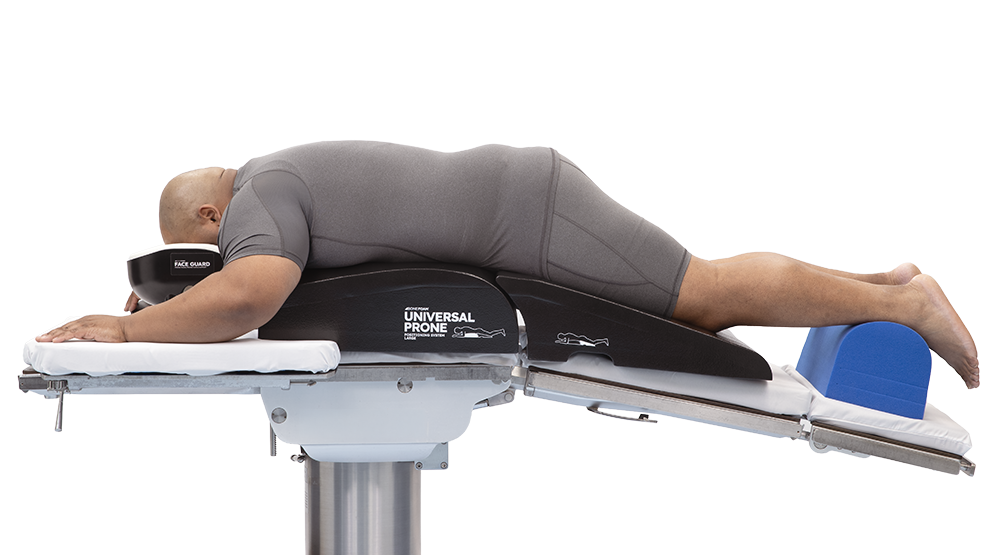
The BoneFoam Universal Prone Solution was designed in collaboration with spine surgeons and anesthesiologists to address these challenges:
-
Open chest cavity architecture
Reduces anterior pressure and supports more natural respiratory mechanics, critical in awake prone patients.⁴⁻⁶ -
Memory foam construction
Distributes pressure evenly, minimizing focal discomfort during longer procedures.⁷⁸ -
Integrated face protection (Face Guard)
Stabilizes and cushions the face without excessive pressure, reducing anxiety and discomfort in conscious patients.⁴⁻⁸ -
Lower extremity support (Shin Guard)
Maintains alignment while relieving distal pressure points that often become intolerable in awake positioning.⁷

Importantly, this system replaces variability with reproducibility. Setup becomes intentional rather than improvised, reducing cognitive load on staff and improving consistency across cases.⁷⁸ Simple, on purpose.
Clinical Insight from Singapore
At the National Neuroscience Institute at Sengkang General Hospital, Dr. Thomas Tan, neurosurgeon and department head, has completed more than 50 awake endoscopic spine cases using BoneFoam’s Universal Prone Solution. “The comfort level of patients has increased significantly since transitioning to the Universal Prone Solution,” Dr. Tan noted following adoption. In awake procedures where patients can speak and respond intra-operatively, comfort is observable, measurable, and immediately validated by patient feedback.²³
Final Thoughts:
The shift toward awake endoscopic spine surgery reflects a broader reality in modern procedural care that patients are no longer passive participants. Comfort, positioning, and experience directly influence outcomes, satisfaction, and adoption.¹³
When patient positioning is treated as a system rather than a workaround, it enables surgeons to focus on what matters most: decompression, precision, and patient performance. Learn more about the BoneFoam Universal Prone.
Learn more about other spine patient positioning solutions here. The BoneFoam Nextend Anterior Cervical Positioning System seen below.

Blog References (Verified)
- Wainwright TW, et al. Enhanced Recovery After Surgery (ERAS) for spinal surgery. Spine. 2016.
- Wagner R, et al. Awake endoscopic lumbar decompression: outcomes and patient tolerance. World Neurosurg.2020.
- Ahn Y. Percutaneous endoscopic decompression under local anesthesia. Spine. 2014.
- Edgcombe H, Carter K, Yarrow S. Anaesthesia in the prone position. Br J Anaesth. 2008;100(2):165–183.
- Kwee MM, Ho YH, Rozen WM. The prone position and cardiopulmonary physiology. Int Surg. 2015.
- Dharmavaram S, et al. Hemodynamic changes in the prone position. Anesth Analg. 2006.
- Rozen WM, Kwee MM, Ho YH. The prone position during surgery: complications and guidelines. Int Surg.2015;100:292–303.
- Cheng MA, et al. Ocular and pressure-related complications of prone positioning. Anesthesiology. 2001.
Additional supporting review:
- Awake spine surgery: current evidence and future directions. Neurospine. 2023. (PMC10200716)
Share: