
The Limb on the Metal Ridge:
A Pressure-Injury Risk You Can Remove.
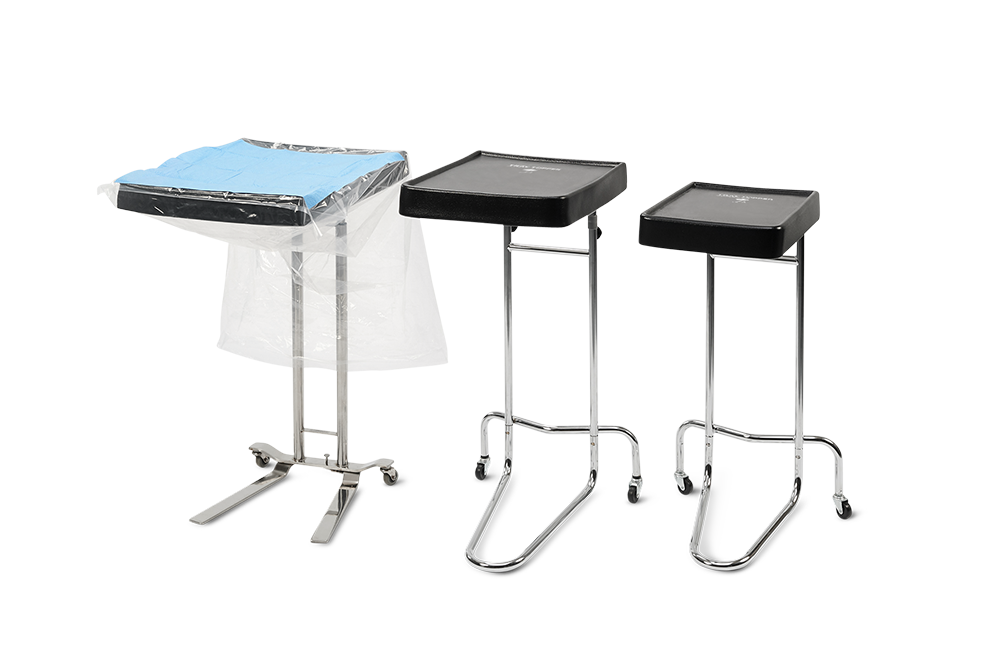
In nearly every operating room, the Mayo Stand does a second job it was never designed to do. Whenever a limb needs to be supported off the table, the Mayo Stand becomes the extremity holder. The limb often rests on that surface for much of the case. Since the stand's surface is a hard metal ridge, the team does the only thing they can by rolling and stacking towels on top of it for the limb to rest on. As a company that has spent the better part of three decades on the surface beneath the patient, we think this small, ubiquitous workaround deserves a second look, because the towel roll on the Mayo Stand carries costs that the OR absorbs.

Procedural Focus: The Extremity Held Off the Table
Repurposing the Mayo Stand as an extremity platform is routine across orthopaedics, supporting the contralateral leg during hip procedures, holding an upper extremity for surgery, and steadying any limb lifted off the table so it can be imaged, prepped, or ranged. In most of these cases the limb rests on that surface for a large portion of the procedure. It is one of the most common improvised positioning tasks.

The Problem: A Hard Ridge and a Pile of Towels
The Mayo Stand was built to carry instruments, not to cradle a limb. Therefore, its surface is a hard, edged plate. Rolled and stacked towels are the standard fix, and they fail in two predictable ways. First, they take time requiring staff to build, roll, and re-roll a stable towel surface for every case, with no standardized setups.

Secondly, towels shift and lose their integrity under the weight of a limb. When they do, the extremity slides down onto the bare metal ridge. Since the limb sits on that ridge for much of the case, that becomes sustained, prolonged pressure on a hard edge. Duration of surgery is itself a significantly recognized risk factor for pressure injury,² so a long case compounds whatever the surface beneath the limb is doing wrong. Intraoperative positioning injuries are a recognized source of perioperative morbidity,² and among the mechanisms of nerve injury (stretch, ischemia, and compression) pressure on the nerve is considered to be the single most important predisposing factor.¹
The surface itself matters: in the dependent lower limb, anterior-compartment pressure has been measured at roughly 57 mmHg on a soft, padded surface and about 64 mmHg on a hard one³ — a hard ridge raises the very pressure the team is trying to avoid. Positioning standards already recognize the Mayo Stand as a pressure hazard around the patient: the Association of Surgical Technology's surgical-positioning standard directs that the surgical technologist must not allow the Mayo Stand to rest on the patient.⁴ Its surface was simply never intended for tissue contact.

The Solution: The BoneFoam Tray Topper
The BoneFoam Tray Topper is a pre-contoured memory-foam topper that fits all standard Mayo Stands, turning the metal plate into a safe, stable platform for positioning extremities off the OR table — for imaging, sterilizing, or ranging. It is a surface built for the limb.
The design choices are simple and do exactly what the problem requires:
1. Memory foam helps protect skin and nerves
A soft, contoured surface distributes load instead of concentrating it on a ridge.
2. Radiolucent
The limb can be imaged in place without the platform getting in the way.
3. Available in three sizes
The BoneFoam Tray Topper is equipped with single-use sterile bags for fast, clean setup, with no towels to roll.

The Benefits of the BoneFoam Tray Topper
Protects the extremity
The memory foam guards against the pressure and nerve injury that a bare metal ridge invites.¹ʼ³
Images cleanly
Because it is radiolucent and stays put during fluoroscopy.
Faster, repeatable setup
A contoured topper and a sterile bag replace the time-consuming towel roll, the same way in every case.
No shift, no slide:
A stable, purpose-made surface instead of a stack of towels or bed sheets that loses integrity mid-case.

References:
- Intraoperative Positioning Nerve Injuries. Anesthesiology Clinics (ScienceDirect topic overview). Positioning nerve injuries arise from stretch, ischemia, and/or compression; pressure on the nerve is considered the single most important predisposing factor.
- Patient Positioning and Associated Risks. Miller's Anesthesia, consolidated chapters "Patient Positioning and Associated Risks" and "Postoperative Visual Loss." Intraoperative positioning injuries are a recognized source of perioperative morbidity; duration of surgery and general anesthesia are risk factors for pressure injury; the literature centers on peripheral-nerve and pressure-related injuries, with padding used to minimize pressure on bony prominences and nerve stretch.
- Compartment Syndrome Due to Patient Positioning. StatPearls (NCBI Bookshelf, NBK553906). Anterior-compartment pressure in the dependent lower limb measured at approximately 57 mmHg on a soft, padded surface versus approximately 64 mmHg on a hard surface.
- AST Standards of Practice for Surgical Positioning. Association of Surgical Technologists. The surgical technologist must not allow the Mayo Stand to rest on the patient.
Share: